Getting Paid to Write Letters, Cards, and Notes in 2026: Is It Worth It?
An honest review for moms
This article is part of my Honest Work-From-Home Report series, where I review the internet’s most popular ways to work from home and make money online. Every opportunity is evaluated using the same framework: startup costs, required skills, earning potential, competition, flexibility, time to first income, and whether it’s actually realistic for busy moms.
If you’ve ever looked for ways to work from home or make money online, you’ve probably come across get paid to write letters, handwritten note jobs, card writing jobs from home, or make money writing greeting cards.
Its advertisements claim you can earn money by writing thank-you cards, sympathy cards, or handwritten notes, all from your kitchen table.
I’ve done the research, and before you waste any energy, I’m here to tell you it’s part legitimate, mainly misleading.
The biggest misconception is that there are a lot of people willing to pay others to write letters all day.
The opportunity I found to be the most sustainable was legitimate businesses that hire contractors to write handwritten notes, personalized cards, direct-mail campaigns, wedding stationery, greeting cards, or custom messages.
Some freelancers also build their own businesses selling handwritten card services to real estate agents, insurance brokers, and small businesses.
What does “writing letters for money” mean?
There are several business models often grouped together:
- Handwritten thank-you notes for businesses
- Greeting card writing
- Personalized poems and letters
- Sympathy and celebration cards
- Wedding calligraphy and invitations
- Direct-mail handwriting services
- Selling custom cards through Etsy
- Freelance copywriting for greeting card companies
How does it work?
You get hired for your writing skills by a customer who needs handwritten or personalized content.
Skills required
| Writing | ★★★★★ |
| Attention to detail | ★★★★★ |
| Handwriting (if applicable) | ★★★★☆ |
| Creativity | ★★★★☆ |
| Organization | ★★★★☆ |
| Customer service | ★★★☆☆ |
| Reliability | ★★★★★ |
Beautiful handwriting helps for some jobs, but reliability, accuracy and creativity usually matter more.
Startup cost
Estimated initially: $20–100 (basically pens, paper or stationery, a computer and, you know, internet).
Once you have some momentum, most freelancers eventually purchase premium stationery, a printer, shipping supplies, an Etsy shop (if you’re selling products) and a website. That brings the estimated cost to $100–500.
Time until first income
Best case: 2–4 weeks. Typical: 1–3 months. Worst case: no clients.
As always, success depends on finding customers rather than simply offering the service.
Time until consistent income
Most freelancers who succeed spend 3–12 months building repeat clients. Businesses that send handwritten thank-you notes regularly are much more valuable than one-time customers.
For handwritten notes, look for realtors, mortgage brokers, financial advisors, photographers, wedding planners, boutiques and other small businesses.
For personalized letters, poems, sympathy cards and custom cards, look on Etsy, Fiverr and local Facebook groups.
If you’d rather write the words than physically write the cards, search greeting-card companies for “freelance writer” or “submission guidelines.” Some publishers accept card copy and poetry directly from writers.
Weekly time commitment
| Learning and setting up | 2–5 hours |
| Building a client base | 5–10 hours |
| Growing consistent income | 10–20 hours |
| Full-time business | 20–40+ hours |
Because this is primarily a service business, your income generally increases as you spend more time serving clients.
How much can you make?
| Stage | Monthly income |
|---|---|
| Beginner | $0–300 |
| Part-time freelancer | $300–1,000 |
| Established business | $1,000–3,000 |
| Specialized service | $3,000+ |
Selling handwritten services directly to businesses generally pays more than accepting one-off consumer orders.
Competition
Competition exists, but this isn’t as crowded as affiliate marketing or Amazon KDP. Many businesses still appreciate personalized handwritten communication because it stands out in a digital world, and demand might be growing.
Barrier to entry: Low
You don’t need a degree or expensive equipment. All you need is to convince someone you can deliver quality and reliability.
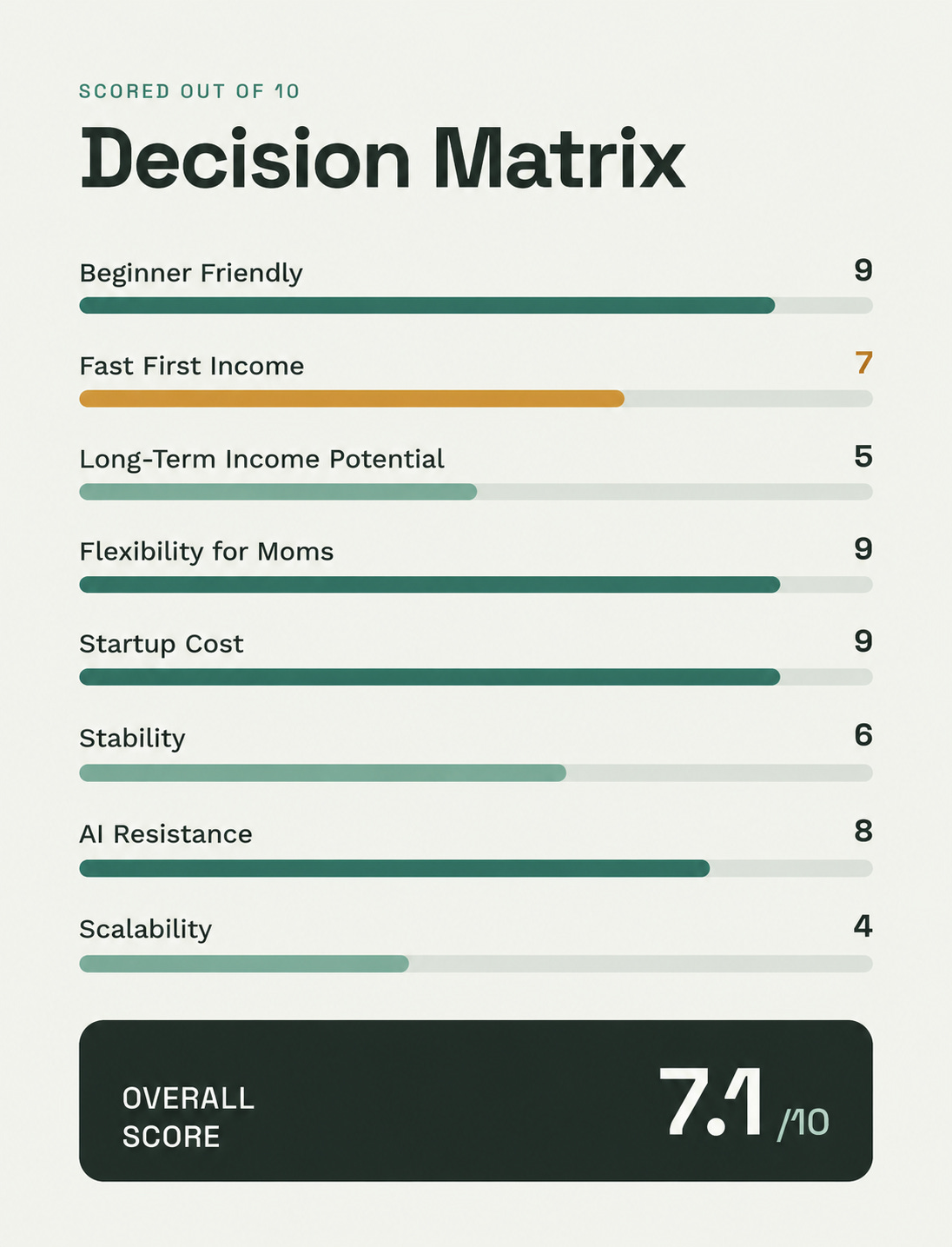
Flexibility for moms: 9/10
This is one of the biggest advantages, because you can write anytime. You can negotiate deadlines and how many projects you take on.
Biggest risks
The main one I’d point out is never finding clients, or finding too few. Some of the jobs on gig platforms are very low paying, and the work has very limited scalability because you have to do it all yourself.
Biggest misconceptions
“Companies hire people to write letters all day.”
Most opportunities involve freelance contracts or running your own small service business.
“It’s passive income.”
No. Every payment requires completing another project.
“Good handwriting is enough.”
Clients also expect reliability, accuracy, communication, and timely delivery.
What successful writers do
- Specialize in one niche
- Build repeat business clients
- Offer premium personalization
- Create professional samples
- Charge based on value, not just time
Where to find clients
Look for opportunities through Etsy, Fiverr, Upwork, local businesses, real estate agents, mortgage brokers, insurance agencies, wedding planners and greeting card publishers. Many businesses send handwritten thank-you cards to customers and outsource this work.
AI impact: 8/10
AI can help draft messages, generate ideas, and improve wording. However, the value of this business comes from the personal, human touch. Handwritten notes remain difficult to automate authentically.
Scalability: 4/10
It has some growth potential through hiring assistants, selling templates, or expanding into stationery products. But it scales much more slowly than digital products or affiliate marketing, because much of the work remains manual.
Mom reality check
It’s great if you like writing and don’t mind dealing with clients. To be successful, you won’t be able to avoid looking for clients, pitching and managing the relationship. Also consider that it’ll take some time to start seeing reliable income.
What I would do
If I needed my first $300… I’d market directly to local businesses instead of relying only on freelance marketplaces.
If my goal was earning $3,000 per month… I’d focus on business clients with recurring orders instead of one-time Etsy sales. I’d also expand into related services like direct-mail campaigns, customer appreciation packages, or premium stationery.
If my goal was long-term freedom… I wouldn’t rely solely on handwritten services. I’d gradually add digital products, printable cards, templates, or copywriting services to create income that isn’t tied entirely to my time.
Final verdict: Good service business, limited scalability
Writing letters, cards, and handwritten notes can be a legitimate work-from-home opportunity, especially if you’re creative and can deliver detail-oriented work.
The biggest advantages are low startup costs, flexibility, and relatively fast access to freelance income. The biggest limitation is scalability: because you’re selling your time, income usually grows only as you take on more work.
If you’re looking for a flexible side business that fits around family life, this can be a realistic option. If your goal is building long-term passive income, I’d eventually combine this service with digital products or another scalable business model.
A version of this post first appeared on Motheredit, my Substack. Subscribe there to get new posts by email.